Network-attached storage drives, NAS for short, appeal to both consumers and businesses. This list, however, is only of concern to the latter, who arguably have the greater need for their capabilities and want to specifically know what are the best NAS drives.
NAS drives are storage devices that combine power and compatibility; they make the management of processing large volumes of data efficient and simple. There is some relatively complex work waiting for you when you take them out of the box for the first time, but it is worth the time and effort in the long run.
There is an abundance of choices here, as there are numerous manufacturers and models on the market. As such, there is a dizzying array of features and capabilities to consider, each with different use cases. For those entering the NAS world for the first time, understanding the market and what is on offer is a daunting task. But it is worth being brave, as it will revolutionize your data management.
What is a NAS drive?
NAS drives are a little like mini servers for smaller-scale use. Usually small enough to fit on a standard desk alongside other computing equipment, the units themselves are dedicated to effective storage management to which multiple devices and users can connect. They make an ideal replacement for small businesses or teams who want to store data locally but don’t want the hassle of managing a full rack-mounted server, or having to manually hook up to bulky hard drives throughout the day.
NAS drives are similar in concept to cloud storage services like Dropbox or Google Drive. They allow multiple people to add to change or create new shared files that can be accessed in real-time. However, because NAS drives are not hosted on the cloud, but rather on a physical device you own, you maintain ownership of the information stored on them, you can decide who else has access, and you can choose exactly where to store the data.
NAS drives can also boast a huge storage capacity versus similar cloud services – usually terabytes worth of storage against modest upper capacities with the latter – and they tend to be more affordable in the long-term, despite a sizeable initial cost; the subscription fees of cloud services add up when looking at the bigger picture.
Synology DiskStation DS2422+
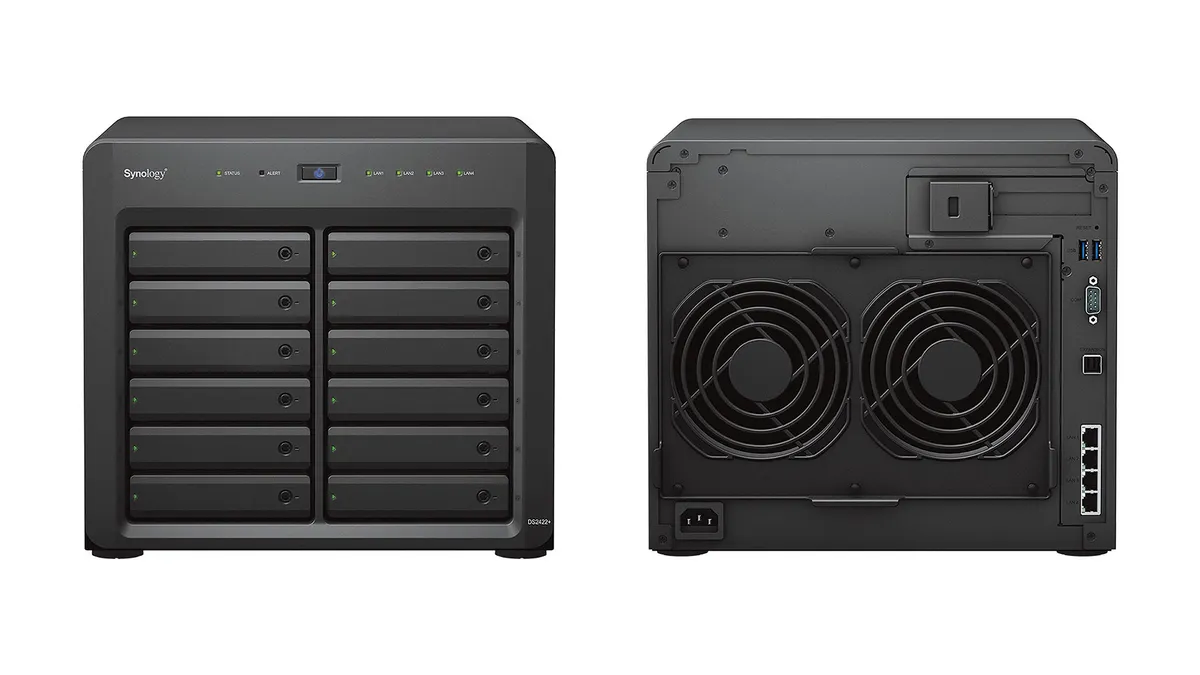
Synology’s DiskStation DS2422+ aims to satisfy storage-hungry SMBs, and this mighty desktop appliance‘s 12 hot-swap storage bays make it a great choice as an affordable high-capacity central backup vault, with plenty of room for services such as file sharing and video surveillance recording. Its Ryzen CPU makes it considerably faster than the Atom-powered DS2419+ and the new DSM 7 software makes the DS2422+ especially appealing.
| CPU | Quad-core 2.2GHz AMD Ryzen V1500B |
| RAM | 4GB ECC DDR4 SO-DIMM (max 32GB with 2 x 16GB) |
| Drive bays | 12 x SATA LFF/SFF, 2 x USB 3, 1 x mini-SAS HD expansion |
| RAID options | RAID0, 1, 10, 5, 6, SHR, SHR2, JBOD |
Price when reviewed: $1,799.99 (diskless)
Read our full Synology DiskStation DS2422+ review for more information.
Asustor Lockerstor 8 AS6508T

If speed’s your priority, then the Asustor Lockerstor 8 is worth a look. Few vendors provide a NAS offering this quick at such an affordable price, with its dual 10GBas-T and 2.5GbE. It's also easy to set up, operate, and use, with a suite of great data-protection applications, making it an impressive enterprise-level choice.
Coming stocked with eight bays, the lockerstor 8 is a powerful office solution, powered by a 2.1Ghz Intel Atom C3538 CPU. It is stocked with a handy 8GB of DDR4 memory that allows for the running of several apps at the same time, while the two SODIMM slots are easy to use if you need an upgrade. The maximum upgrade level of RAM caps out at 32GB.
| CPU | 2.1GHz Intel Atom C3538 CPU |
| RAM | 8GB DDR4 SODIMM (max 32GB) |
| Drive bays | 8 x hot-swap SATA drive bays, 2 x M.2 NVMe/SATA slots |
| RAID options | RAID0, 1, 5, 6, 10, JBOD |
Price when reviewed: $1,130.64
Read our full Asustor Lockerstor 8 AS6508T review for more information.
Buffalo TeraStation TS3420DN
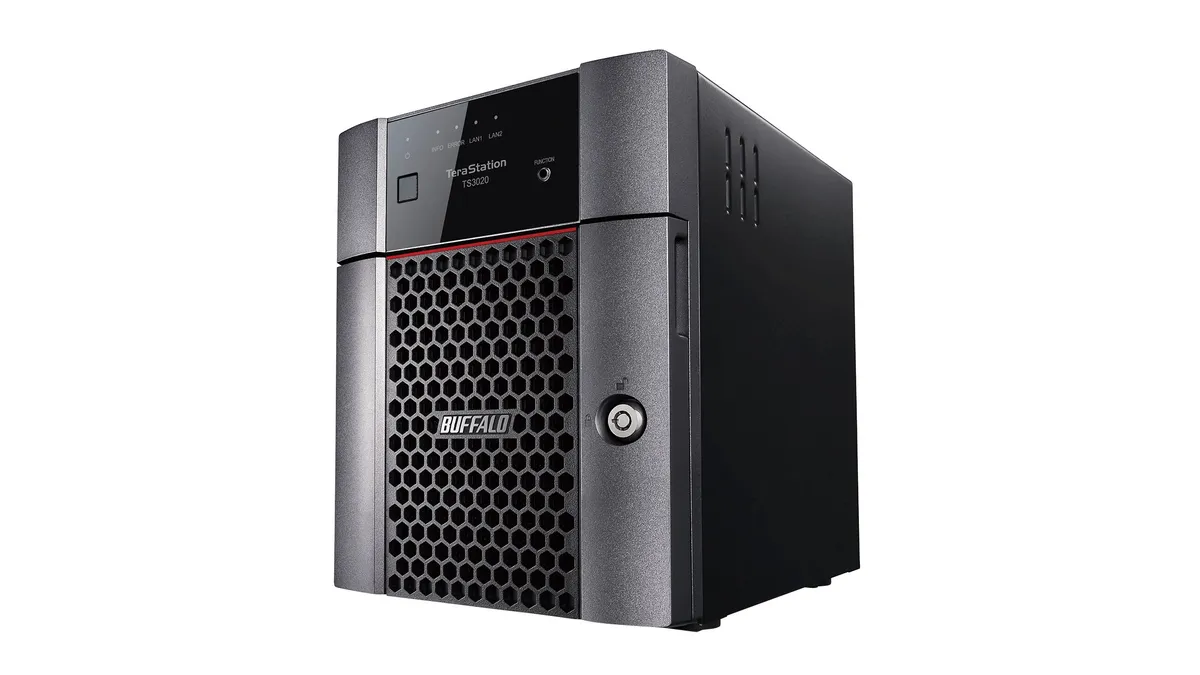
Small and medium-sized businesses (SMBs) can't always get away with small and medium-sized data-transfer capacities, which is why the Buffalo TeraStation TS3420DN is a solid option. It comes equipped with a four-bay design that allows for 2.5GbE, promising users speeds that are more than double the regular gigabit connection over Cat5e network cabling.
The model sent to us for review came fitted with four 1TB Seagate IronWolf SATA drives in hit-swap carriers behind the front door, though this NAS Drive is also offered in 8TB,16TB, and 32GB capacities. It doesn’t offer diskless use, though the attached three-year warranty does cover the included drives. The Buffalo TeraStation’s impressive set of backup and security systems also make this a trustworthy appliance for all of your businesses important data, and it’s fairly affordable as well.
| CPU | 1.4GHz Annapurna Alpine AL214 CPU |
| RAM | 1GB DDR3 (maximum 1GB) |
| Drive bays | 4 x 1TB Seagate IronWolf hot-swap hard disks |
| RAID options | RAID0, 1, 10, 5, 6 |
Price when reviewed: $669.43 (4TB)
Read our full Buffalo TeraStation TS3420DN review for more information.
QNAP TS-h973AX
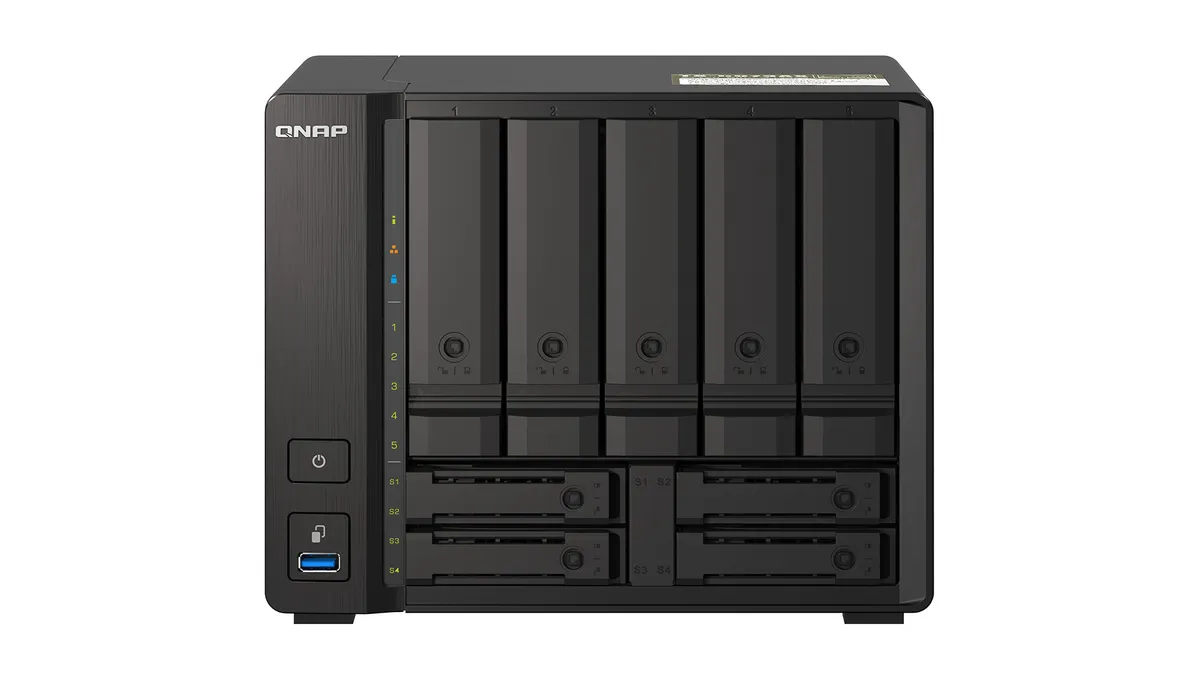
Though the name is a bit of a mouthful, QNAP’s TS-h973AX still makes a memorable impression through a combination of affordable price-point and enterprise-level data security. QNAP’s offering has a quality set of comprehensive features that make it a powerful all-round performer, even despite a misleadingly small casing. The price is great too, and it was a stand-out favourite during testing.
QNAP has had some issues with cyber attacks, however, with a number of sustained ransomware campaigns occurring throughout 2022 that targeted the company's NAS drives. It suffered some reputational damage to the brand after failing to proactively secure its products against a flurry of Deadbolt attacks. That being said, some of the success of these attacks can be attributed to a lack of patches by product owners; QNAP itself provided a fix only 12 hours after the attack began in one occurrence. It’s still something to consider, though, when deciding on which NAS drive to purchase.
| CPU | 2.2GHz AMD Ryzen V1500B |
| RAM | 32GB DDR4 ECC (max 64GB) |
| Drive bays | 5 x LFF, 4 x SFF (2 x U.2 NVMe) |
| RAID options | RAID0, 1, 5, 6, 10, 50, 60, triple parity, triple mirror |
Price when reviewed: $1,724.61 (32GB)
Read our full Qnap TS-h973AX review for more information.
Qnap TVS-h874T

Power and functionality combine in the Qnap TVS-h874T which provides users with a choice of either Intel’s Gen12 Core i7 or Core i9 CPUs. We reviewed the more affordable version as well, which runs on a 12-core Core i7-12700E CPU. On top of that, the QNAP is built with 32GB of DDR4 memory that can be upgraded to 64GB.
With ‘h’ in the name of the model this level of memory is important, as Qnap is clearly focusing this NAS on its QuTS hero OS. This is a more demanding NAS for a more demanding OS. The functionality of the TVS-h874T’s OS is similarly palpable, offering improved data protection with its ZFS copy-on-write that delivers NAS and iSCSI LUN snapshots along with inline deduplication and compression.
| CPU | 2.1GHz 12-core Intel Core i7-12700E |
| RAM | 32GB DDR4 SODIMM (max 64GB) |
| Storage | 8 x SATA LFF/SFF, 2 x M.2 2280 PCIe 4 NVMe SSD slots |
| RAID (QuTS) | RAID0, 1, 5, 6, 10, 50, 60, Triple Mirror, Triple Parity |
Price when reviewed: $2,899 (Core i7, 32GB)
Read our full Qnap TVS-h874T review for more information.
Qnap TS-855eU-RP

Size isn’t everything, as the QNAP TS-855eU-RP can testify to with eight 3.5in SATA drive bays slotted into a chassis that’s just 297mm deep. It’s nearly the shortest 2U rack NAS device out there, perfect for fitting into the working environments of space-poor SMBs. It could slot easily into a small wall box or a two-post rack cabinet.
The TS-855eU-RP runs on a reasonably modern 2.8GHz 8-core Intel Atom C5125 processor, with a base 8GB of DDR4 RAM that can be upgraded to 64GB. It has dual 2.5GbE ports along with a pair of PCI-E expansion slots. Even though the motherboard is just 12cm deep, Qnap has also found a way to fit in a couple of M.2 NVMe slots.
| CPU | 2.8GHz 8-core Intel Atom C5125 |
| RAM | 8GB DDR4 (max 64GB) |
| Drive bays | 8 x SATA, 2 x 2.5GbE, 2 x PCI-E |
| RAID options | Single, RAID 0 (Stripe), 1, 5, 6, 10, 50, 60, Triple Mirror, Triple Parity |
Price when reviewed: $1,599 (8GB)
Read our full Qnap TS-855eU-RP review for more information.
Synology DiskStation DS1823xs+

Always popular with SMBs, Synology’s eight-bay desktop NAS appliances offer high storage capacity in a desk-friendly format with plenty of features. The Synology DiskStation DS1823xs+ is no exception, providing users with two m.2 NVMe SSD slots behind the left-hand drive bays. These can be used as performance-enhancing cache or as a standard storage pool.
The DS1823xs+ is restricted to Synology’s HAT5300 HDDS, SAT5200 SSDs, and SNV3400 M.2 NVMe SSDs, however, so be careful when choosing storage devices. Generally, though, this powerful eight-bay NAS is a great choice for SMBs looking for quality storage capacity at a reasonable price.
| CPU | Quad-core 3.35GHz AMD Ryzen V1780B |
| RAM | 8GB DDR4 ECC (max 32GB) |
| Drive bays | 8 x LFF/SFF hot-swap SATA drive bays |
| RAID options | Supports RAID0, 1, 10, 5, 6, hot-spare, JBOD |
Price when reviewed: $1,799.99
Read our full Synology DiskStation DS1823xs+ for more information.
QNAP TS-873A
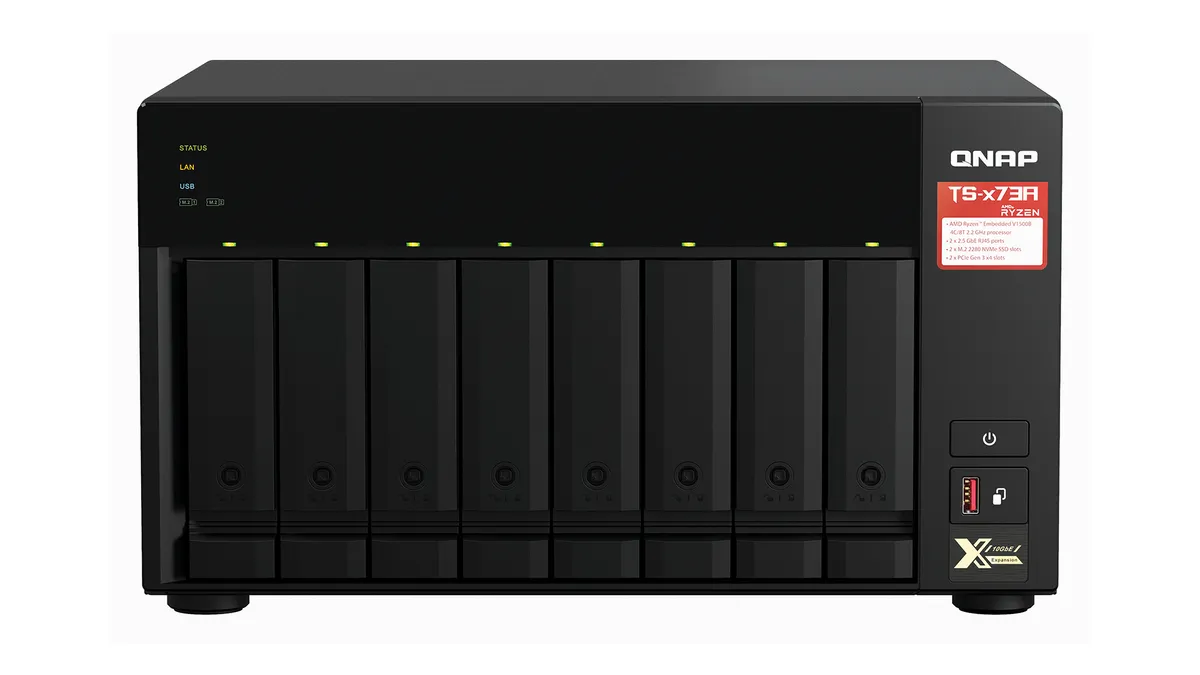
QNAP’s eight-bay TS-873A desktop appliance has the flexibility to fit a range of business needs, with users being able to choose between QNAP’s standard QTS operating system or the more advanced QuTS hero platform. Its storage options are just as versatile, with internal M.2 NVMe SSD slots and eight front-facing SATA drive bays supporting both mechanical disks and SSDs.
The TS-873A also comes equipped with a quad-core 2.2GHz AMD Ryzen V1500B CPU and excellent software support, with 109 apps available for QuTS and 123 for QTS. Overall, it adds up to a very impressive and flexible desktop NAS, with plenty of expansion potential thanks to dual PCIe slots.
| CPU | 2.2GHz AMD Ryzen V1500B processor |
| RAM | 8GB DDR4 (max 64GB) |
| Drive bays | 8 x LFF hot-swap drive bays, 2 x M.2 NVMe SSD slots |
| RAID options | Supports RAID0, 1, 5, 6, 10, 50, 60, Triple Parity, Triple Mirror (with QuTS) |
Price when reviewed: $1,193.67 (8GB)
Read our full QNAP TS-873A review for more information.
How we test NAS drives
NAS performance is dependent on more than simply the drives you fit into them; internal configuration of a NAS can, for example, affect its suitability for different roles. So to give you the best measurements of performance, ITPro runs a series of benchmark tests on each NAS drive we review.
If a NAS comes pre-populated with drives, we'll use those for the tests, but diskless units will be fitted with NAS-specific SATA HDDs, configured either in the manufacturer's own RAID system or in a RAID5 configuration (or RAID1, for units with less than four bays).
For real-world performance, we measure copy jobs to and from a connected PC, using both mixed-file batches and large single files to measure backup speeds and sequential transfers. We also use CrystalDiskMark for raw read and write speeds.
When it comes to more business-focused NAS drives and appliances, our testing methodology changes slightly compared to connected storage devices. First, we'll install and set up the unit using NAS-specific SATA HDDs in a four-drive RAID5 configuration (or RAID1 for appliances with fewer than four bays). We then connect the appliance to a test server via 10GbE, either using the standard RJ-45 or fibre SPF+ ports, or by fitting an adapter card if necessary.
To test real-world performance, we copy a 25GB test file to and from our server to measure read and write speeds, timing how long the process takes to complete. We'll also test encryption write performance by copying the 25GB file to an encrypted share.
We also use the open-source Iometer tool to test raw sequential read and write performance to an iSCSI target – this allows us to state the likely maximum speeds that the NAS is capable of.